Folly

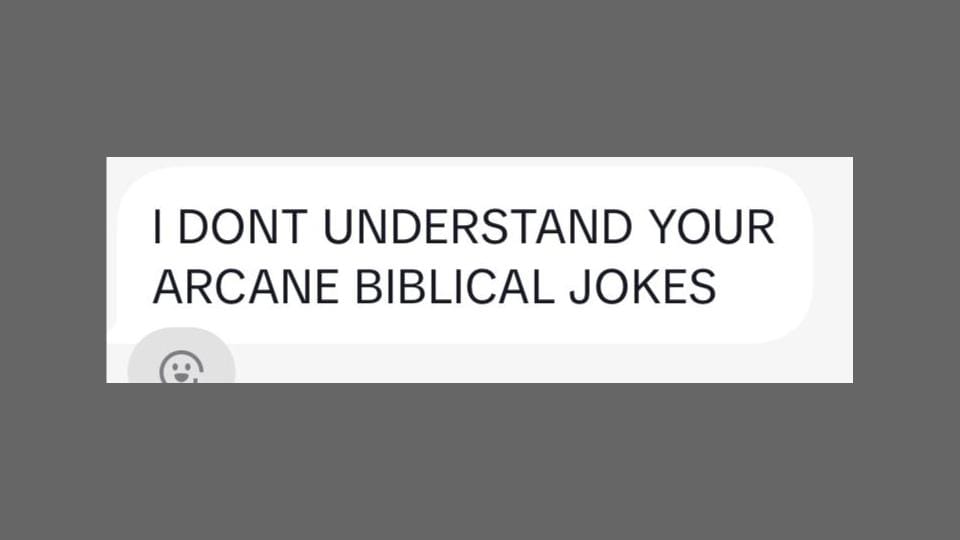
I was gonna “brag” here in the opening paragraph. I was gonna talk about the Bible Belt - that region in the southern United States replete with evangelicals, where I come from, and where I escaped. And I was gonna explain that not only was I from the Bible Belt, but I spent a lot of my years in multiple cities that bragged about being “the Buckle of the Bible Belt.” It’s a phrase that communicates “we are SOOOO evangelical that we have a position of prominence ABOVE the rest of God’s Country.” But it turns out that none of the places I’ve lived have enough claim to the title of “Buckle” that they’re even listed on Wikipedia’s chapter about the holy battle for the title. I’ve never actually lived in one of the main contenders. (For my money, looking now at the “official” nominees, I gotta hand it to Tulsa. I remember being driven around Oral Roberts University in that city, hosted by proud locals showing me the huge “praying hands” statue. If you wanna find serious church-goers, that’s where they live.)
The point is, I grew up in a part of the country where people were competing with each other over how evangelical they were. And for many years, I was clearly losing.
To be fair, there wasn’t a time in my childhood when I would have been able to claim anything other than “evangelical” on my census. I went to my Methodist services, and I was around Salvation Army members of my family, and I attended “Vacation Bible School”, and I spent some grades in religious academies, and I still know so many “Silly Songs with Larry” by heart. I was always filled with plenty of Christian bona fides.
When I got to college, the Evangelical Legitimacy Games heated up. It didn’t hurt that I was at a Baptist university. And it didn’t hurt that there was a girl I wanted to impress. And it didn’t hurt that a confusing transitional period like college is a prime place to go’a’proselytizing. But in college, I learned that all that time spent in church was not enough to get a passport for the Kingdom of Heaven. You had to really believe. You had to be born again. You had to have a personal relationship with Jesus Christ. Whatever that means.
In my years in evangelicalism, that last bit was always in the top ten of most frustrating things. “A personal relationship with Jesus Christ.” No one ever really gave me a clear answer on what it meant, but they all seemed to know anyway. It felt like a secret that I could never learn, but would send me to hell for not knowing. From what I gathered, it was always about being “spiritual”. When you pray, you can “hear” god talk back to you. When you sing worship songs, you raise your hands to the heavens, not as choreography, but because you “feel” the spirit move through you. When you measure the moral value of a decision, you aren’t leaning on a deliberate understanding and evaluation of right and wrong, you just “know” what god wants you to do. I never had any of that. None of those feelings ever came. The big clue that Christianity was never gonna work for me was that I was always “religious, but not spiritual.” All the woo woo mysticism of the church washed off of me like I was Teflon. But the religious part? That I could figure out.
Even if I pretended otherwise, Christianity was never a vessel for me to have a transcendental connection to the divine. It was always other things. First and foremost, it was an identity. I was in a “Christian” culture, and I was illegitimate in that culture unless I acknowledged my sinful guilt before god and publicly accepted Jesus as my savior. Secondly, it was a way to solidify my moral system and worldview. I always had and always will have a strong internal sense of right and wrong, good and evil. And at a formative age, I was given a stress-tested-over-millenia framework to make sense of my moral instincts. If there’s anything that still kinda sticks from my days in the church, it’s this. The moral argument for the existence of god is one I still have a hard time dismissing entirely.
But I couldn’t just be a Christian. Any regular old Christian could be a Christian, and Christianity is a competitive sport. To be legitimate in the eyes of my peers, I had to be an EXCEPTIONAL Christian. But I was severely handicapped by my allergy to mysticism, which was one of the key marks of “true faith”. The only option I had was intellectualizing my faith. And, as a huge blessing to me, it was trendy to do so.
Bestsellers in the late nineties and early aughts were filled with authors like Rick Warren or Joel Osteen, talking about the Christian faith in the language of Oprah. What can give you a “Purpose Driven Life?” Jesus, of course. How can you live “Your Best Life Now?” By acknowledging your sin. Evangelicalism had been successfully Reagan-ified - the purpose of living for god wasn’t to make the world better; it was to build your own happiness in a kind of “two point five kids and a garage” way. And the further it went away from relatively-well-meaning Rick Warren and toward snake-in-the-grass Joel Osteen, the more evangelicalism veered into dangerous, exploitative territory, where the message ended up meaning, “If you give me money to build a bigger church and buy a yacht, god will give the money back to you in turn.”
But by the time I started trying to take my faith more seriously, something new came along, and it was really old. In the mid-to-late 2000s, a different kind of voice gained prominence on Christian radio, in bookstores, and in pulpits. Outsiders called it “New Calvinism”, but under our gilded roofs it was branded as the “Young, Restless and Reformed” movement. Either way, predeterminism was having its moment, as god had planned it. All of a sudden, the Christian book charts started to see a new generation of speakers and preachers, and their writing was surprisingly distinguishable from Dove wrappers. Timothy Keller had a mainstream NYT bestseller in “The Reason For God”, a summary of apologetics in laymen’s terms. John Piper sold “Desiring God”, interpreting the works of John Calvin and Jonathan Edwards for modern times. Christian Radio started playing sermons that sounded more like Martin Luther than Tony Robbins. It was just the tip of the iceberg for the rise of this new brand of evangelicalism, and it grew strategically and exponentially. In addition to media, these same thought leaders founded “church planting” networks, building up young reformed pastors and sending them to build new churches out of abandoned grocery stores all across the nation. For good, and for ill.
At the time, it felt like protestants were filled with divine fervor and zeal, responding to a changing world, turning to reformed theology as a chassis for making sense out of the Christian worldview in a secular internet age. In hindsight, it seems like a marketing tactic to win back young men enthralled by the “New Atheists”, giving a dry run on some strategies now employed by the “manosphere.” For me, someone who felt lost in her identity, eager to please the systems around her, and struggling to perform faithfulness adequately, it was quite literally a godsend. If I couldn’t believably cry during repetitive worship music, I sure as heck could learn more theology than everyone else. I finally had an alternate model to become the “super Christian” everyone was disappointed in me for not being. So I bought “Systematic Theology” textbooks, I learned every letter in TULIP, I read Jonathan Edwards and Martin Luther and the “acceptable” writings of those pesky catholics Thomas Aquinas and St. Augustine. I got addicted to podcasts by filling my hours with sermons from churches I would never visit. I fought anyone who suggested that anything but grace through faith led to salvation, and suggested they might go to hell for believing otherwise. And I started to be admired as a spiritual fount instead of an unholy desert.
Here, years later, long after having left the church, I’ve got all this stupid theology rotting in the dustbins of my mind. And I don’t know what to do with it. All this knowledge of the bible, and every single section of the bible, and it’s largely useless. The pentateuch is filled with such foundational literature, and one can’t understand the western literary canon without at least a passing understanding of what it contains. But it also is mostly instructions on what goats to slaughter on what sepulchers. The histories of Judea have some juicy bits… and also are filled with boring genealogies and claims of racial superiority. The prophets are largely gobbledygook. The gospels are, once again, very important texts… and have interesting ramifications*. And the epistles are the foundation for much of protestant theology - philosophically interesting and societally toxic.
(*A quick aside on Jesus. If you want me to roll my eyes hard, start telling me that today’s church isn’t following the teachings of the man. There’s a sexy secular Jesus that non-christians like to brandish as a rhetorical weapon against the cruelty of conservative theocracy, and I don’t think it’s wholly without merit. But real ones who have read the “canonical” gospels know - the Christian figure of Jesus has a lot more in common with dogmatic bigots than it does with imagined liberal firebrands.)
That just leaves the Wisdom books. Smack dab in the middle of the tome, we have five (or seven) books, not on theology, not recounting events, not transcripts of a bad salvia trip, but thinking. They’re still my favorite part of the Bible. And they’re the one part I’d still recommend even secular people read.
Psalms is the longest of this section - 150 or so poems about the nature of god, ranging from “all is well with god on my side” to “I will bash Babylonian babies’ heads on rocks”. Job is a morality play about how to retain faith when life is punishing. Song of Songs is a sex bop. Ecclesiastes… is probably the best. Randomly we get thirteen chapters of proto-existentialism, talking about how all life is meaningless and the only way to make sense of the world is to submit to god’s will, if I can grossly oversimplify.
But Proverbs has my favorite part. There are some extended sections that talk about the nature of wisdom, but the vast majority of the book is a long list of aphorisms. And my absolute favorite pair are in chapter 26, verses 4 and 5:
Do not answer a fool according to his folly, Lest you also be like him.
Answer a fool according to his folly, Lest he be wise in his own eyes.
Here we have it. The self-proclaimed wisest book in the world, in its section devoted explicitly to wisdom, giving conflicting advice about foolishness. God that’s fun.
It’s harder to find evangelicals up here in New England, a land that’s never claimed to be any kind of bible belt buckle. But it happens occasionally. And if they aren’t indoctrinated enough to immediately dismiss me as satanic because of my gender, I don’t know how to act. I remember the days when I was in their shoes, wise in my own eyes, trying the best tactics to make the gospel seem attractive to heathens. Here, on the other side, being sold heaven instead of trying to sell it myself, I don’t know whether to reveal that I used to be one of them. There’s a chance I could be a way out for someone else who’s trapped, showing that life can be glorious outside of the confines of the church. Or I could just be escalating a hazardous conversation, leading to hurt and misunderstanding on both sides, leaving the world more fractured and polarized than it was before. I see their folly, and I realize it takes wisdom and discernment to know how to answer it.
And then I remember these verses. And I can only think, “goddamnit.”